Logistics & Transportation

The logistics and transportation industry in Mexico consists in the exchange of goods (manufactured, mining, oil, among others) by air, sea, road and rail.
▪ The logistics and transportation industry reported US$4.3 trillion in revenue globally in 2018
▪ In 2018, the industry generated more than 2.3 million direct jobs through the transportationof 790.0 million tons of goods
▪The industry in Mexico contributes5.5% of the total GDP
▪ Due to trade tensions between Mexico and USA, the logistics and transportation industry growthis expected to slow down in 2019 and 2020
▪ The industry is expected to increase manufactured goods exports, which account for around 80% of total goods exports
▪ Mexico’s total trade is expected to increase from US$1.1 trillion to US$1.4 trillion between 2019 to 2023
Mexico is ranked 54th out of 137 countries evaluated in the Global Competitiveness Index 2017-2018 of the World Economic Forum, which assesses the performance of countries in 12 pillars of competitiveness, including infrastructure.
▪ Mexico holds the 62th place regarding infrastructure quality with a rating of 4.3 out of 7.0
▪ Road and air transportation were rated highest in infrastructure quality with a 4.4 score, while rail scored the lowest with 2.8 points
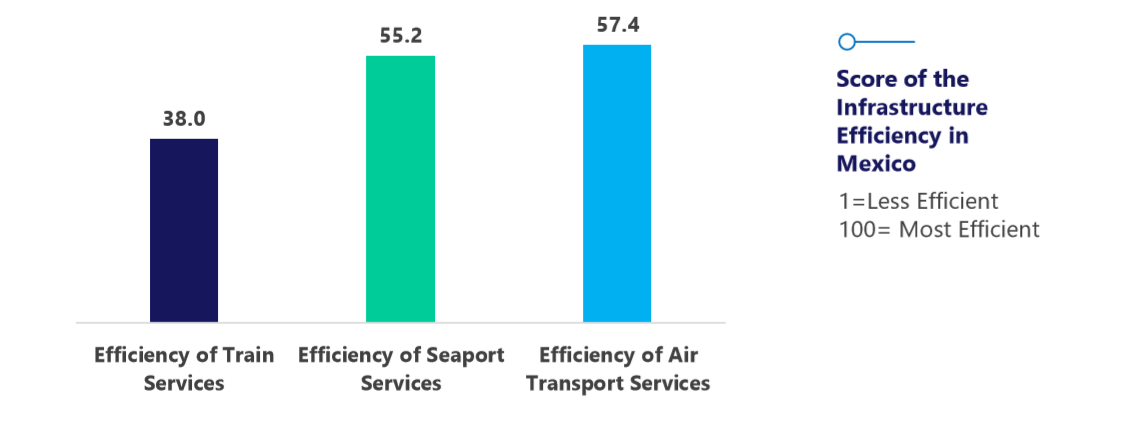
▪ In terms of efficiency, Road connectivity was ranked best in the country with a score of 90.3 out of a 100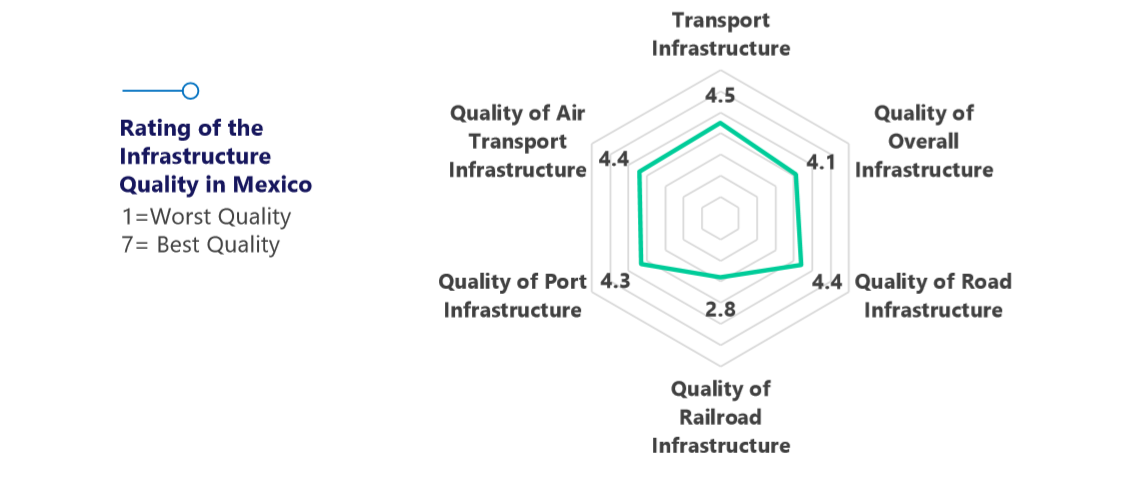
Total trade is expected to grow 5.5% during 2019 but to slowdown to 4.2% in 2020.
▪ An increase in e-commerce is expected to boost the industry growth in the mid-term, especially the road freight sector
▪ Private consumption will continue to play an important role in the economy and is expected to boost freight volumes
▪ Rail freight is well-positioned to grow due to new concessions and permits as a result from the country’s Energy Reform 2013
▪ Due to the cancelation of the Texcoco international airport in Mexico City and the delay of Santa Lucía Airport, air freight volume grow this expected to decrease to 1.1% in 2019
▪ Investments in the energy sector and in the ports of Manzanillo and Veracruz are expected to encourage the use of sea freight

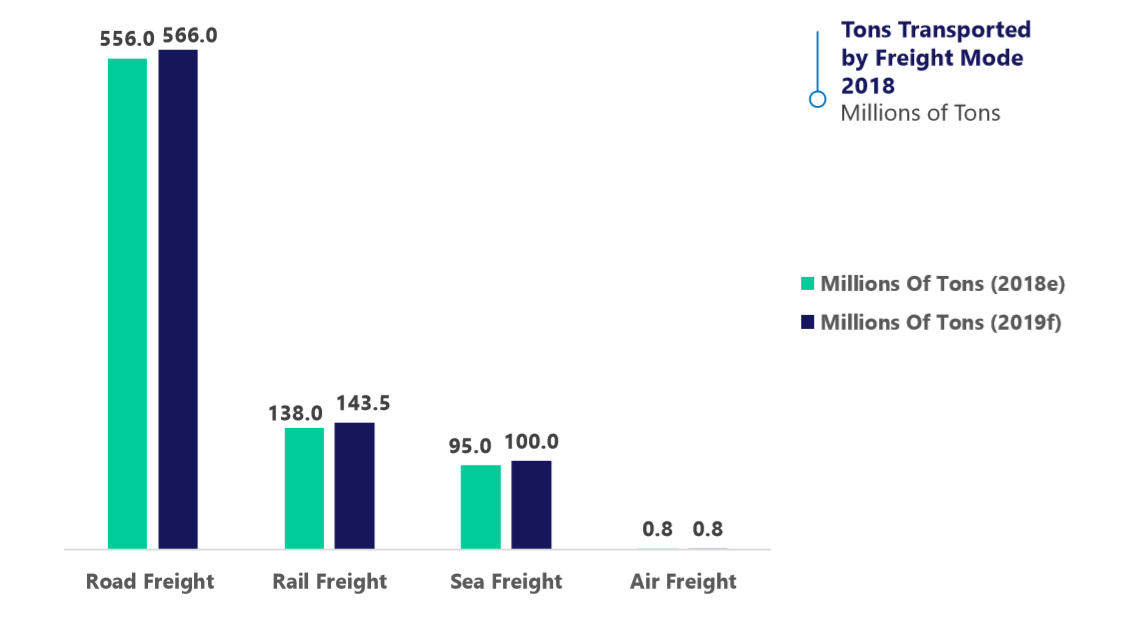
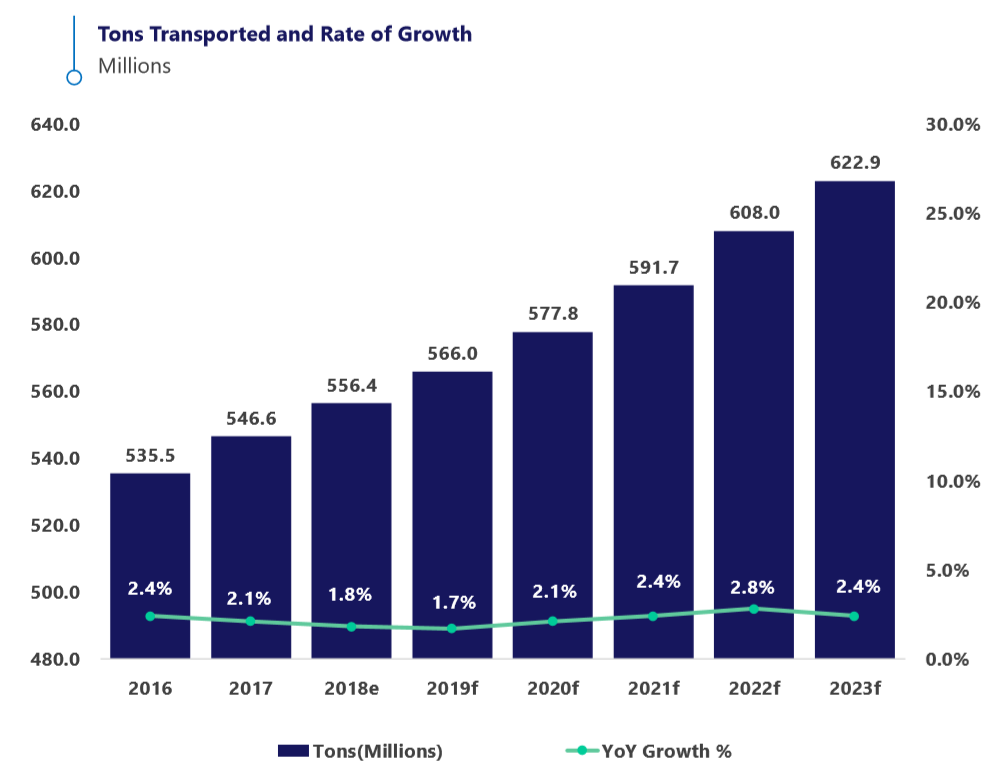
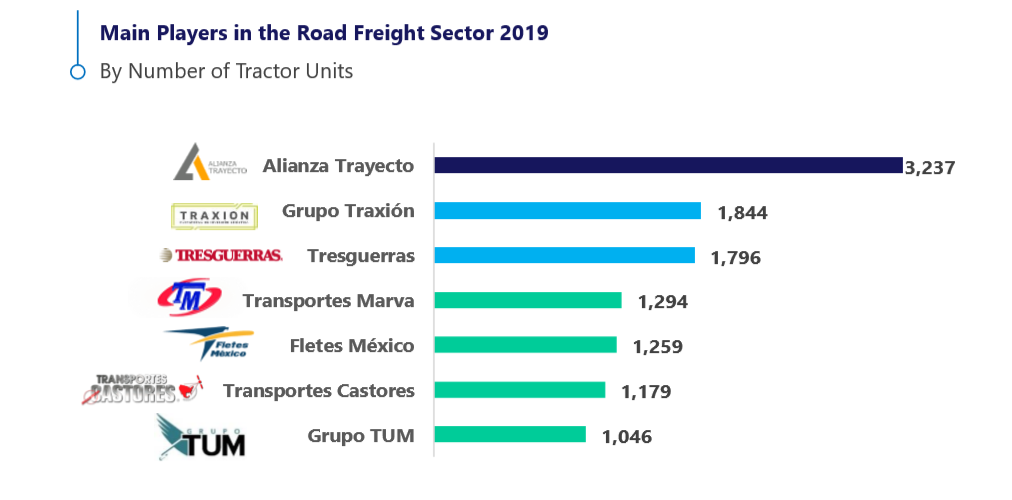
The road freight sector is the most widely used transportation method in the industry, moving 70.4% of the domestic volume with a total of 556.0 million tons and with a total fleet of 982,856 vehicles as of December 2018.
▪A 1.7% growth in road freight is expected to reach 566.0 million tons in 2019. Growth for the sector is expected to average 2.3% until 2023
▪ Expected tonnage output of 623.0 million tons in 2023
▪ An expected boost for the sector may be the Public-Private Partnership model for road maintenance
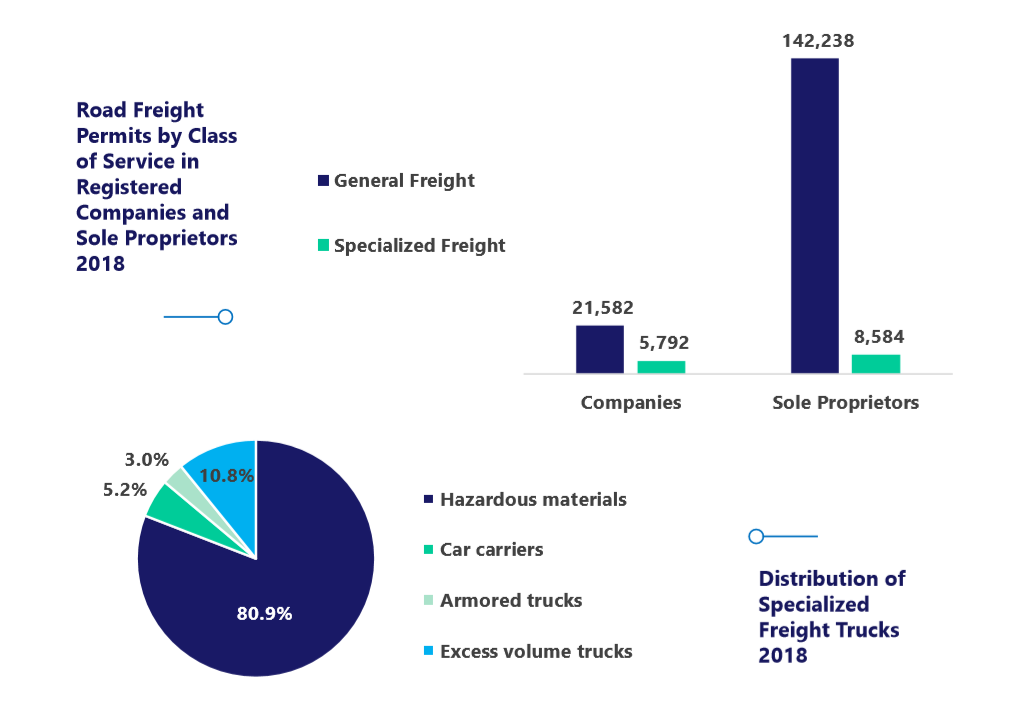
There are two types of services: general freight (transfer of any type of goods without any specialized equipment) and specialized freight (transport of materials, waste, bulky objects, hazardouswaste, funds and securities)
▪ In general freight and specialized freight, Mexico City is the entity with highest quantity of units with 193,350, followed by Nuevo León with 138,383 and Jalisco with 66,802
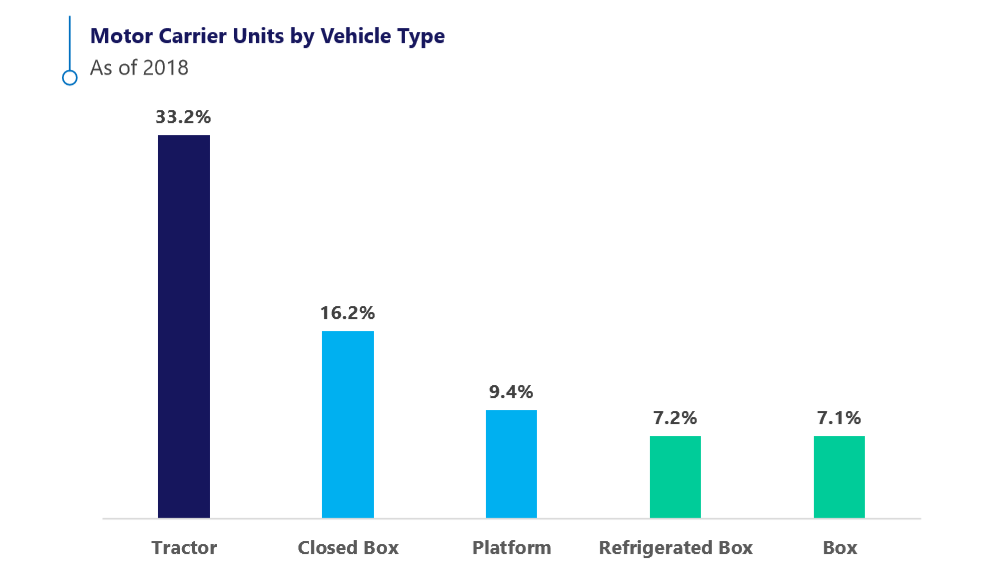
▪ The motor vehicle fleet of freight transport is divided into 3 classes: by (1) motor units (2, 3 and 4 axles trucks and 2 and 3 axle tractors), (2) by trawls (semi-trailers from 1 to 5 axes), as well as (3) by industrial cranes

Rail freight transport is the second mode of freight transport in Mexico moving 17.5% of the national load, representing a total of 138.0 million tons in 2018.
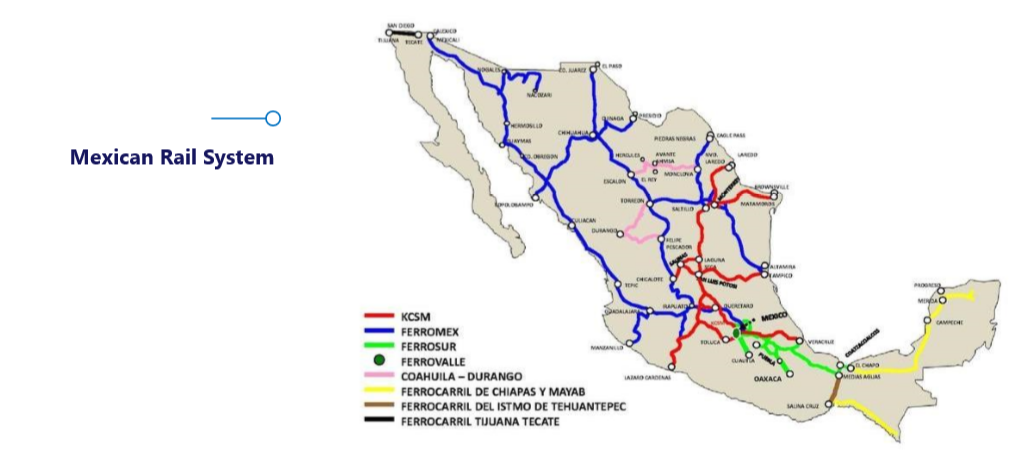
▪ In 2018, Mexico reporteda total length of 26,914 km of railway lines
▪ Freight transportation resulted in the most common use of railways in Mexico with a total of 32,286 freight cars
▪ Despite the short-term slowdown, medium-term growth is expected to grow by an average of 3.8% until 2023
▪ The National Fund for the Promotion of Tourism in Mexico launched a bid for the construction of the 1,525km of the Train Maya Project railways. It will stretch from Palenque to Cancun,and connect 5 states
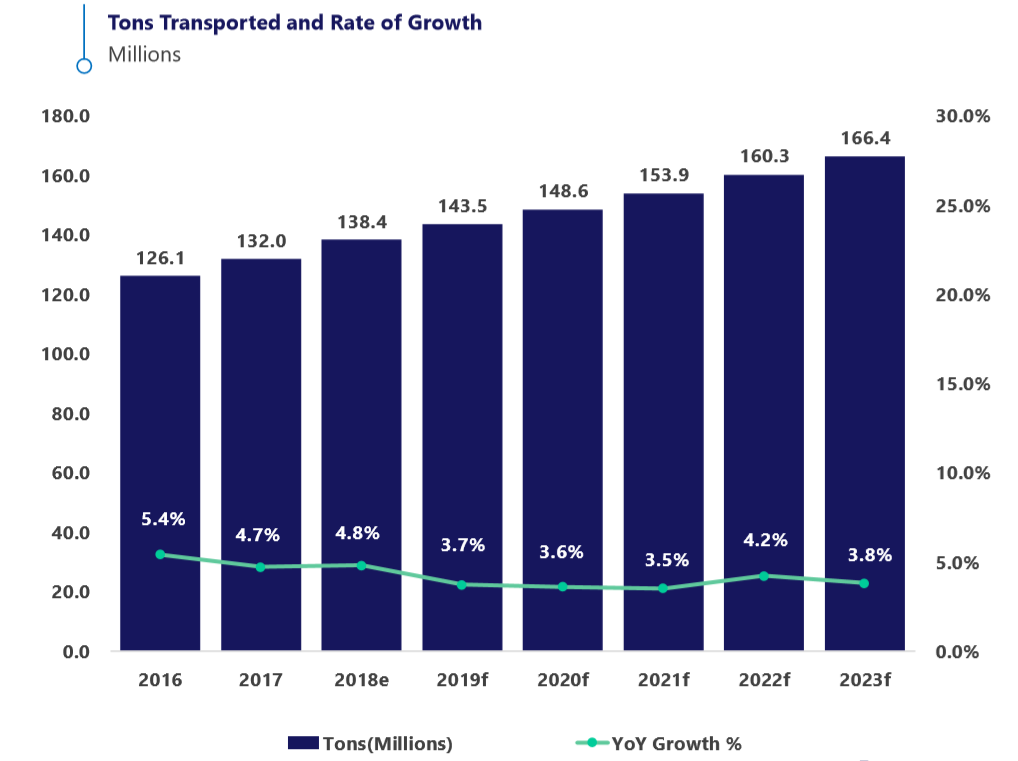
Forecast growth is expected to slow down to 3.7% in 2019 from 4.8% in 2018.
▪ More than half of the railway lines have been awarded to private operators. The largest three players are Ferromex(8,121km), KCSM (4,250km), and Ferrosur (1,824km)
▪ Forecasted investment on railway lines for 2018 totaled US$1.1 billion between private and public investments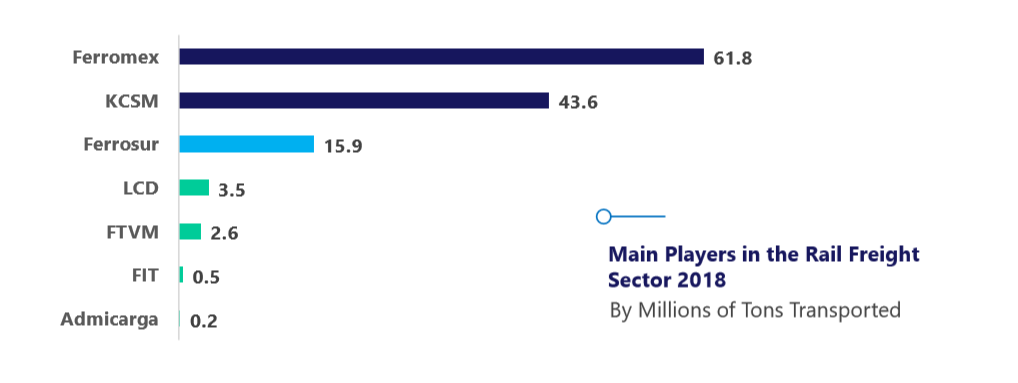

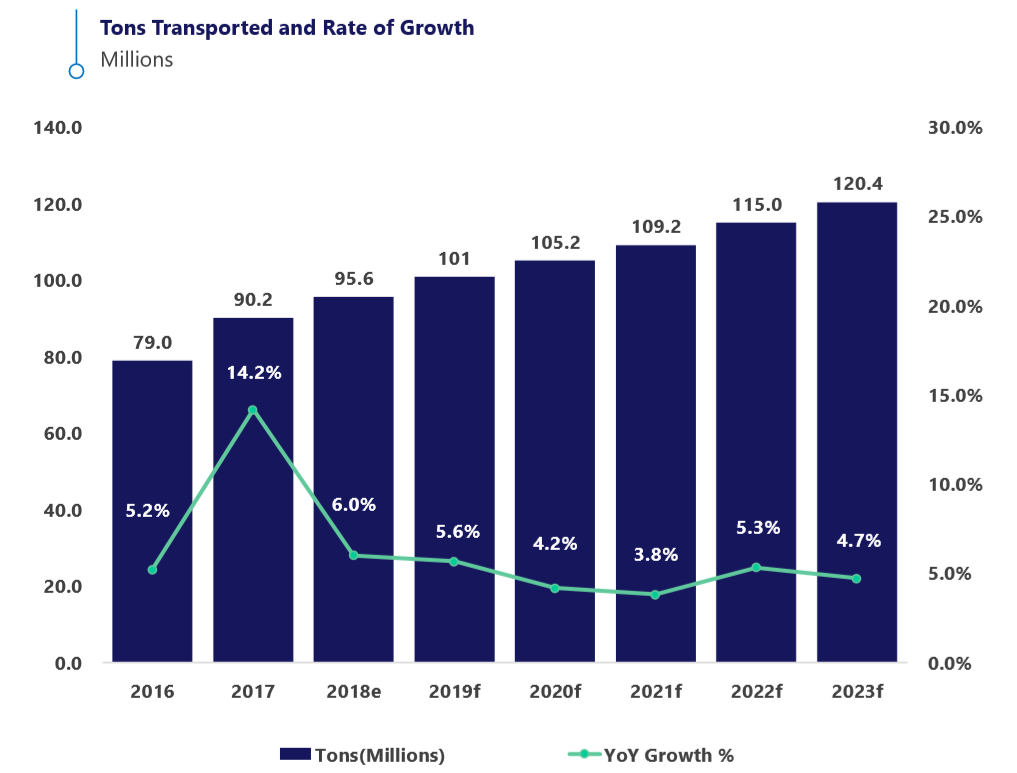
The freight shipping is the third mode of transport by tonnage, moving 12.3% of the national freight with a total of 95 million tons in 2018; an average annual 3-5% volume growth is expected for 2019-2023.
▪ Maritime transport is responsible for 90% of world trade
▪ Veracruz port will undergo an investment of US$1.5 billion that is expected to increase its capacity from 22 million tons annually to 90 million. It is expected to overtake Manzanillo port’s capacity and to reportan annual average growth rate of 3.6% over 2019-2023
▪ The investment is key since Veracruz port is part of main transport hubs in US East Coast, Europe, Africa, LatinAmerica and the Caribbean
▪ US$1.2 billion investment was announced for the port of Manzanillo. This expansion will be comprised of 4 new terminals: One with 1.75 million tons of extra capacity, and the other three for bulking agricultural, mineral and hydrocarbon products


Air freight transport is the fourth mode of transport in Mexico, moving 0.1% of the national freight with a total of 830 thousand tons transported in 2018.
▪ Of the total transported freight, 19.0% went to a national destination and 81.0% thousand tons were international
▪ The three most recurred freight routes nationally were Mexico City- Guadalajara, Tijuana-Mexico City, Monterrey- Mexico. Internationally Mexico- City- Los Angeles, Mexico City-Frankfurtand, Los Angeles- Guadalajara were the most recurredroutes
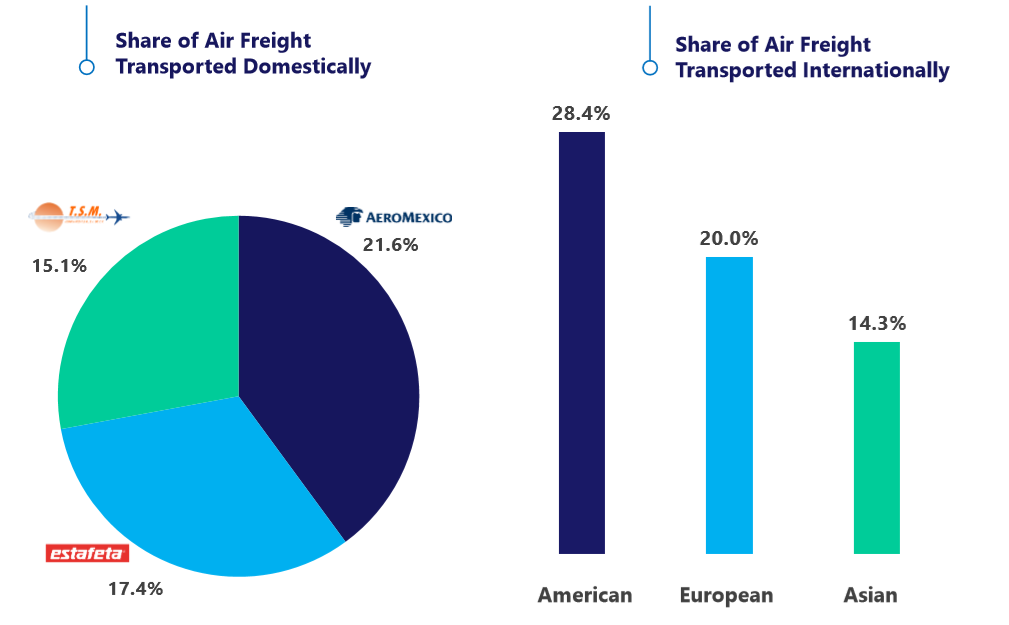
▪ National airlines transported 310 thousand tons, with Grupo Aeroméxico being the air freight company that transported the most with 21.6% of the total share
▪ Internationally, total freight volume was led by American freight companies with a 28.4% market share
▪ The airport in Mexico has the highest freight volume transported, followed by the airport in Guadalajara
An average annual growth of 1.8% is expected in the 2019-2023 period, making air transport the transport method with the lowest growth for the projected period with a total of 891.4 thousand tons in 2022.
▪ During the 2016-2018 period the sector grew at an average rate of 6.1%
▪ Air freight will grow 1.1% in 2019 and 1.6% in 2020

-
BMI Research
-
Capital IQ
-
Fitch Solutions
-
iContainers
-
Mergermarket
-
SCT
World Bank
-
World Economic Forum